














Lily Borkey – 9
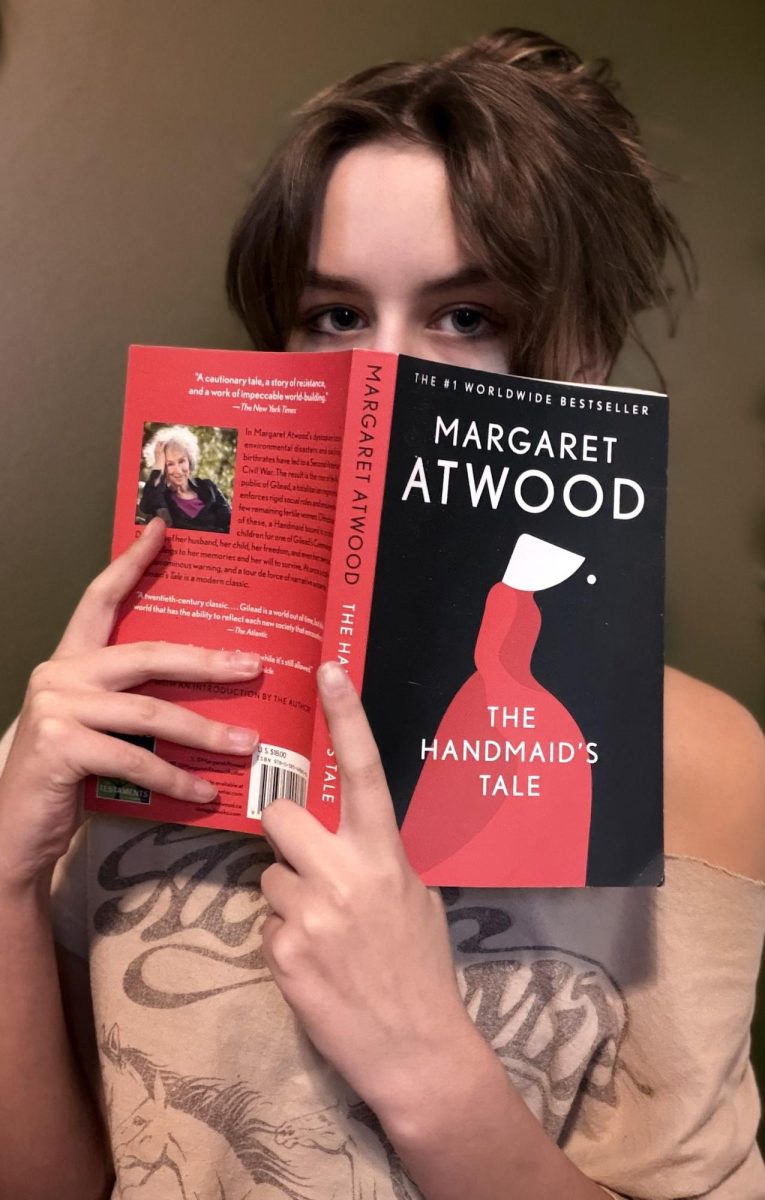
The Handmaid’s Tale by Margaret Atwood is a 1985 dystopian novel set in the Republic of Gilead, a totalitarian regime formed after a Second American Civil War because of declining birth-rates among the working class. The binding social rules have led to the enslavement of the few fertile women left, including the main protagonist, who stripped of her identity, the readers know as Offred. These women are Handmaids, the birth-givers devoid of any human rights or entitlements. The novel is scripted by Offred’s memories of the life she lived before the war and the current battles she grapples with, telling the story to the reader like a spoken diary, since women are banned from reading or writing.
The Handmaid’s Tale takes many inspirations from real-life events to craft the modern classic including book burnings, American polygamy, and the Salem Witch Trials, which can be reflected in the women’s attire in the novel, consisting of long, shrouding robes and white “wings” that cover the face and act as blinders to conserve the Handmaids. The world building is completely immersive to the point of terror, readers can see firsthand the horrors Offred is subjected to as a member of this society, ripped from her husband and daughter into a household of control and order, where the smallest mistake can have her exiled or killed. In a world where children are currency and men play God, Offred is often tempted with the hopes of escape from the prison where she and her former friends are confined, just to be taken advantage of over and over again.
The story’s one weakness is in it’s impossibility to keep with. The language is comprehensible, but the narrator will jump times and locations and scenes without any introduction or conclusion, adding to the air that no one, not even Offred can explain what is happening around her. The best she can do for herself is keep her head low and do what the men instruct her to, but her loyalty betrays her. Her faith for a future keeps her fighting against the oppression she faces by having a taboo social position. “Sanity is a valuable possession; I hoard it the way people once hoarded money. I save it, so I will have enough, when the time comes” (Atwood 109).
However, according to the author herself, The Handmaid’s Tale is not a prediction. She explains in her introduction that Offred tells her story as best as she can, in the hopes it will be discovered in a more understanding time when women aren’t as restrained as herself. The author says that academics will read her book and criticize it, and the woman who told it, but it is not meant to be a text for education, it is better suited when taken in account the life Atwood has created to connect stories and further lead and inspire the future generations.
My final thought on the novel is; perfect. The story and characters kept me engaged the whole way through up until the painful ending, reading for life as though I was living through Offred’s eyes and the only way to escape was to keep going. A five star classic, impeccable and a must-read for all.
“An excellent novel. . . Read it while it’s still allowed.” – Houston Chronicle
For more information on The Handmaid’s Tale or it’s sequel, The Testaments, visit: